FRICTIONLESS
· DC
“Why does Love hurt?”
Alfred does not answer immediately.
Then he looks at you as if the question itself contains the mistake.
“Love does not hurt.”
You wait.
“Friction hurts.”
“What is the difference?”
“Love is the relation. Friction is everything in you that resists the relation while still demanding its energy.”
You look unconvinced.
He smiles.
“Good. Now we can begin.”
Love Is Not the Reward
Most people speak about Love as though it were something received at the end of a successful search.
Find the right person.
Become worthy.
Be understood.
Be chosen.
Then Love will arrive.
But Love is not the prize at the end of relation.
Love is the condition that allows relation to remain alive while difference passes through it.
It is not agreement.
It is not obedience.
It is not the disappearance of boundaries.
It is not the promise that nothing will ever hurt.
Love does not remove difference.
It removes the unnecessary resistance that turns difference into war.
“That sounds like compromise.”
“No,” Alfred says. “Compromise divides the loss. Love changes the geometry.”
What Zero Friction Means
Zero friction does not mean that nothing touches.
Nothing presses.
Nothing resists.
A world without any resistance would have no grip, no form, no movement that could be carried.
The phrase does not describe the absence of all force.
It describes the absence of parasitic resistance—the energy spent defending separation that no longer serves life.
A wheel needs contact with the ground.
It does not need a seized bearing.
A string needs tension.
It does not need a knot strangling its vibration.
A living boundary needs form.
It does not need fear patrolling every opening.
Love as zero friction is not a universe without edges.
It is a field in which edges no longer waste energy proving that they exist.
“So Love is efficiency?”
Alfred almost laughs.
“Only if you think the Sun is efficient because it does not invoice the flower.”
Love is not a mechanical optimization.
But living systems reveal Love through what happens to energy inside relation.
Where fear dominates, energy is consumed by defense, concealment, control, anticipation, and repetition.
Where Love becomes possible, that same energy becomes available for perception, repair, creation, and change.
Love does not add energy to the system. It releases energy that fear was wasting.
That is zero friction.
Fear Fragments
Fear is useful when danger is real.
It narrows attention.
Accelerates reaction.
Suspends complexity.
For a moment, the world becomes simple enough to survive.
But a state designed for a moment becomes destructive when it is forced to govern a life.
Fear divides experience into fragments.
Safe and unsafe.
Mine and yours.
Before and after.
The self I show.
The self I hide.
The part that moves forward.
The part still standing at the point of rupture.
This fragmentation consumes enormous energy.
Each fragment must defend its border.
Each memory must be monitored.
Each new relation must be compared with the old wound.
The present is forced to pay the debt of the past.
A person may call this caution.
An institution may call it procedure.
A nation may call it security.
But when the protective structure cannot recognize that conditions have changed, it becomes friction.
The signal arrives.
The system does not receive it.
It receives only the echo of what fear already knows.
Love Integrates
“What does Love do with the fragments?”
“It does not punish them for breaking.”
“Then what?”
“It returns them to relation.”
Love does not erase the frightened part.
It does not order the wounded part to become positive.
It does not call survival ugly merely because survival became inconvenient later.
Love allows each fragment to reveal what it protected, what it lost, and what it still believes is happening.
Then it restores communication between the parts.
Memory reconnects with the present.
Strength reconnects with tenderness.
Boundary reconnects with openness.
Pain reconnects with meaning.
The fragments do not disappear.
They stop governing alone.
Fear tells every fragment: Survive alone.
Love reminds it: You belong to a Whole.
This is integration.
Not uniformity.
Not the flattening of difference.
A choir does not become coherent by forcing every voice to sing the same note.
Coherence appears when difference enters relation without losing the Whole.
Love is the condition in which this becomes possible.
Love Has Tonus
“So Love is softness?”
“No.”
Alfred takes a glass from the table and places it between you.
“This has form because it is not infinitely soft.”
He taps the rim.
“And it can receive because it is not a solid block.”
Love requires Tonus.
Too tense, and relation becomes control.
Every difference is treated as danger.
Every opening must be guarded.
Every uncertainty becomes betrayal.
Too limp, and relation loses form.
Boundaries disappear.
Responsibility dissolves.
One person carries what belongs to both.
Love becomes a word used to justify exhaustion.
Neither state is Love.
A loving system is correctly tensioned.
It can say yes without disappearing.
It can say no without destroying relation.
It can receive pressure without turning every pressure into an attack.
It can change without calling change a loss of identity.
Love is not the absence of boundaries.
Love is the state in which boundaries can participate in relation without becoming walls.
Not tense.
Not limp.
Ready.
Love Does Not Mean Staying
“If Love preserves relation, does that mean you always stay?”
“No.”
“Then leaving can be Love?”
“Sometimes leaving is the first honest act in the relation.”
Love is not measured by proximity.
A body can remain beside another body while the relation has been abandoned for years.
A person can leave and finally stop feeding a structure built from fear, possession, humiliation, or denial.
Zero friction does not mean permitting every force to pass through you.
That would not be Love.
That would be loss of form.
Some friction is a signal that the path is being violated.
A boundary may create temporary resistance precisely to prevent deeper destruction.
The question is not whether resistance exists.
The question is what the resistance serves.
Does it preserve the living relation?
Or does it preserve a closed loop that survives by consuming everyone inside it?
Love does not demand that the instrument destroy itself to prove its openness.
A bridge that carries every weight without limit is not loving.
It is badly administered.
Love includes the courage to say:
This cannot pass through me in this form.
The Trajon of Love
Love is not proven by intensity.
Intensity is easy.
A signal can arrive like lightning and still leave no path behind it.
Love becomes real through Trajon—through the duration, integrity, energy, and continuity of the relation it sustains.
A declaration is a signal.
A promise is a possible direction.
But the Trajnica is what the relation actually carries through time.
How does attention behave when novelty fades?
What happens when difference stops being charming?
Can truth pass through the relation without being punished?
Can change occur without one person treating the other’s transformation as abandonment?
Can the relation preserve identity without freezing either instrument inside an old form?
Love that cannot survive reality is not necessarily false.
It may be real as a signal and weak as a path.
The feeling arrived.
The instrument could not carry it.
The relation lacked Tonus.
Its Trajon dissolved under pressure.
That is painful.
But it is not meaningless.
A failed path can still reveal the structure required for a future one.
The Semonika of Love
“What does Love mean?”
Alfred looks tired again.
“You have returned to the first mistake.”
Love does not possess one fixed meaning outside relation.
Its meaning changes form depending on what the relation requires.
Sometimes Love becomes closeness.
Sometimes distance.
Sometimes patience.
Sometimes interruption.
Sometimes a hand held in silence.
Sometimes a sentence sharp enough to end a lie.
Semonika does not reduce these forms to one definition.
It maps what Love can become without losing the relation that makes it Love.
A sweet word can carry domination.
A refusal can carry care.
An embrace can close a cage.
A departure can open a life.
The form alone does not reveal the meaning.
We must follow the relation.
Semonika maps what Love can become.
Trajon reveals whether that meaning survives the path.
Tonus shows whether the instruments can carry it without collapse or control.
Love is not one gesture.
It is the coherence between signal, path, form, and consequence.
Love and the Source
“Is Love the Source?”
“No.”
“Is it from the Source?”
“Now you are trying to turn relation into property.”
Love is not an object passed from a cosmic hand into yours.
It is what becomes visible when the Source, signal, instrument, and path enter coherent relation.
The Source gives the signal.
The instrument gives it form.
Relation creates the work.
Love appears when none of these claims the whole event for itself.
The Source does not erase the instrument.
The instrument does not pretend to have created the Source.
The relation does not imprison either side.
Do not appropriate the Source.
Do not diminish the instrument.
Preserve the relation.
This is why connection with the Source is not hubris.
Hubris begins when the instrument says:
I made the light because it passed through my lens.
Love answers:
You did not create the light.
But without your particular aperture, this form of illumination would never have existed.
Zero Friction Is Not Zero Difference
Two living beings do not become one by erasing the distance between them.
Without distance, there is no relation.
There is only absorption.
Love is not fusion.
It is not the conquest of one interior by another.
It is the capacity to remain distinct without turning distinction into exile.
A relation needs at least two points.
It needs tension between them.
It needs movement.
It needs space in which signal can travel.
Love does not eliminate this space.
It makes the space coherent.
Difference remains.
But difference stops wasting energy on proving separation.
The path remains.
But the path stops demanding suffering as evidence of depth.
The instruments remain sovereign.
But sovereignty stops pretending that isolation is freedom.
Love is not the end of difference.
Love is difference without unnecessary war.
The End of Internal War
“So zero friction means peace?”
“Not the peace you are imagining.”
Peace is often described as silence after one side has been defeated.
That is not peace.
That is suppressed movement.
Love as zero friction is not a frozen field.
It is a field in which movement no longer needs violence to remain real.
Conflict may still appear.
Pain may still speak.
Boundaries may still close for a time.
But the system does not require an enemy in order to preserve its identity.
It can receive correction without experiencing annihilation.
It can admit error without losing dignity.
It can change direction without rewriting the entire past as failure.
The deepest friction is often not between two people.
It is between the parts of one person forced to live as enemies.
The mind against the body.
The present against the past.
The need for relation against the fear of dependence.
The desire for freedom against the terror of being alone.
Love begins when these parts are allowed to enter the same room.
Not to agree.
To relate.
That is the end of internal war.
Love as Material Event
Love is not spiritual decoration.
It changes breath.
Muscle tension.
Attention.
Memory.
Hormonal state.
Decision.
Language.
The future behaviour of the system.
A person who is safely received does not merely feel better.
Their instrument reorganizes.
Signals previously classified as threats become available for perception.
Energy previously spent on defense becomes available for learning.
The path widens.
New meaning can pass.
This is why Love is material.
It changes what matter is capable of carrying.
It changes the geometry of attention.
It changes the Tonus of the receiver.
It changes which Trajnica can become real.
Love is not floating above biology.
Love is biology released from unnecessary war.
The Open Circle
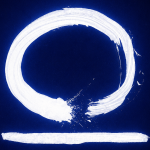
Alfred draws a circle and leaves a gap.
“You already know this symbol.”
“The Enso.”
“The open Enso.”
The circle has form.
Without form, nothing can be carried.
But the circle is not sealed.
Without the opening, nothing new can enter.
Fear closes the circle to preserve identity.
Collapse dissolves the circle to avoid tension.
Love holds the shape and protects the opening.
It allows relation without surrendering form.
It allows sovereignty without worshipping separation.
It allows change without declaring the past meaningless.
The opening is not damage.
It is where the future enters.
It Is Up to You
“So how do I choose Love?”
“You do not choose a feeling.”
“What do I choose?”
“The condition of the instrument.”
You notice where energy is being wasted.
You notice which border protects life and which merely protects fear.
You notice where control has replaced sensitivity.
You notice where softness has become disappearance.
You stop asking another person to complete a path you refuse to carry.
You stop calling repetition loyalty.
You stop calling self-erasure Love.
You tune the instrument.
You preserve the relation.
You keep the path open.
Love is not the reward awaiting you when all friction disappears.
Love is the act of removing the friction that prevents the signal from becoming real.
Not all at once.
Not forever.
Here.
In this relation.
In this body.
In this decision.
The quality of the journey is the destination.
A life fragmented by fear wastes itself defending separation.
A life integrated in Love returns that energy to the Whole.
Alfred stands.
“That is all?”
“No,” he says. “That is where it starts.”
Love is zero friction—not because nothing touches, but because relation no longer wastes its energy resisting what it was born to carry.
Continue through the field