TONUS BEFORE THE TONE
· DC
Tense, relaxed or limp
A string left slack cannot carry it at all.
Between those two failures exists a precise and living condition: enough tension to preserve form, enough openness to receive movement. Ready state.
That condition is Tonus.
We usually speak about tension as though less were always better. We imagine relaxation as the disappearance of force, the surrender of structure, the point at which the body and mind finally stop resisting.
But a living system without tension is not free.
It is unable to respond.
A bridge without tension does not become peaceful. It collapses. A sail without tension does not become open. It loses the wind. A nervous system without readiness does not become calm. It becomes unavailable to the moment.
Relaxation is not the absence of tension. It is the correct distribution of tension.
Tonus is the geometry of that distribution. Readiness of the system to respond to input.
Three States of the Instrument
Every instrument can become too rigid, correctly tuned, or unable to hold its own form.
These are not moral categories. They are states of readiness.
Tense
The tense system tries to preserve itself by preventing movement.
Its structure becomes rigid. Its attention narrows. It spends energy defending the current shape instead of receiving new information.
The signal arrives, but the instrument cannot move with it.
What should have passed through becomes trapped. What should have become adaptation becomes friction. Control increases because sensitivity has decreased.
A tense system may appear strong because it resists change.
But resistance is not strength.
A structure that cannot bend must either stop the world or eventually break against it.
Relaxed
The relaxed system is not weak.
It maintains form without closing itself.
It can receive pressure, redistribute it, and return to coherence. It does not respond to every signal with panic, nor does it allow every signal to pass without distinction.
It remains awake.
Elastic.
Available.
This is the state in which perception can become action without unnecessary internal conflict.
The instrument does not disappear.
It becomes precise.
Limp
The limp system has lost the tension required to support relation.
Its boundaries no longer guide movement. Signals enter but do not acquire direction. Energy disperses before it can become form.
This is not openness.
Openness requires an edge.
A circle must retain enough structure to remain a circle, even when it is not closed.
Without Tonus, the instrument does not become free of control. It becomes unable to carry a path.
Tonus Is Not Mood
Tonus is deeper than whether you currently feel energetic, calm, motivated, or tired.
It is the current capacity of a system to support change without losing coherent load-bearing capacity.
A person may feel intense emotion and still possess Tonus.
A person may appear calm while internally avoiding every signal capable of changing them.
The question is not:
“Do I feel relaxed?”
The question is:
“Can my present structure receive this signal, remain in relation with it, and allow it to change me without rupture or collapse?”
Tonus is not passive comfort.
It is readiness.
The Open Circle
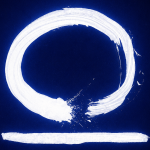
The Enso is often treated as an image of incompleteness.
But the opening is not a defect.
It is the point through which relation remains possible.
A completely closed circle can preserve what is already inside it, but nothing new can enter without being treated as an invasion.
A circle with no structure cannot preserve anything at all.
Tonus keeps the circle open without allowing it to dissolve.
When the system is tense, the circle closes and hardens. The signal rebounds from its boundary or becomes trapped inside it.
When the system is limp, the circle loses its form. The signal passes through without leaving a coherent trace.
When the system is relaxed, the circle remains open and load-bearing.
The signal can enter.
Attention can carry it.
Trajon can preserve its continuity.
Trajnica can become the actual trace of its passage through a particular consciousness.
An open system is not a system without boundaries. It is a system whose boundaries can participate in meaningful change.
Tonus, Trajon, and Semonika
Tonus does not decide what a signal means.
It determines whether the instrument is capable of carrying the process through which meaning becomes real.
Semonika maps what meaning can become.
Trajon preserves the path through which it becomes real.
Tonus tells us whether the instrument is ready to carry that path.
Without Semonika, readiness has no meaningful direction.
Without Trajon, a possible transformation has no continuity.
Without Tonus, the path has no instrument capable of sustaining it.
This is why insight alone is never enough.
A person may recognize a truth and still be unable to live it. The idea exists. The destination is visible. But the instrument cannot yet carry the required path.
This is not hypocrisy.
It is a problem of Tonus.
The response is not to repeat the truth more loudly.
The response is to prepare the instrument.
The Administration of Tension
Sovereignty is often imagined as unlimited control.
But a sovereign instrument does not control every event, every signal, or every internal reaction.
It governs tension.
It decides what must remain firm, what must soften, what must be released, and what must be strengthened.
Too much control produces rigidity.
Too little administration produces collapse.
Competent administration creates readiness.
This applies to a body, a mind, a relationship, an institution, or an entire society.
A system ruled through constant pressure becomes tense.
A system abandoned without structure becomes limp.
A system capable of distributing power, attention, and responsibility according to real conditions becomes relaxed.
Not passive.
Not uncontrolled.
Ready.
The Geometry of Change
A meaningful change requires two things that appear contradictory:
The system must remain itself long enough to receive the signal.
And it must be capable of becoming something it was not before.
If it changes too easily, nothing persists.
If it refuses to change, nothing becomes.
Tonus holds these two demands in relation.
It preserves coherence without turning coherence into a prison.
It allows movement without confusing movement with dissolution.
This is the deeper geometry of stability:
Stability is the frame in which change has meaning.
A stable frame is not one that prevents transformation.
A stable frame is one that can receive meaningful change.
The frame holds coherence long enough for change to become form.
That duration is not stillness.
It is living tension correctly distributed across the whole.
Not Tense. Not Limp. Ready.
The purpose of Tonus is not to achieve permanent calm.
No living instrument remains in one state forever.
Pressure changes.
Signals change.
The world asks different things from us at different moments.
The work is not to eliminate tension.
The work is to tune it.
To notice when strength has become rigidity.
To notice when openness has become loss of form.
To restore the condition in which signal, attention, and action can remain in relation.
Not tense.
Not limp.
Ready.
Coherence is not a destination.
It is the continuous act of maintaining the right tension between the will to act and the capacity to let go.
Continue through the field